
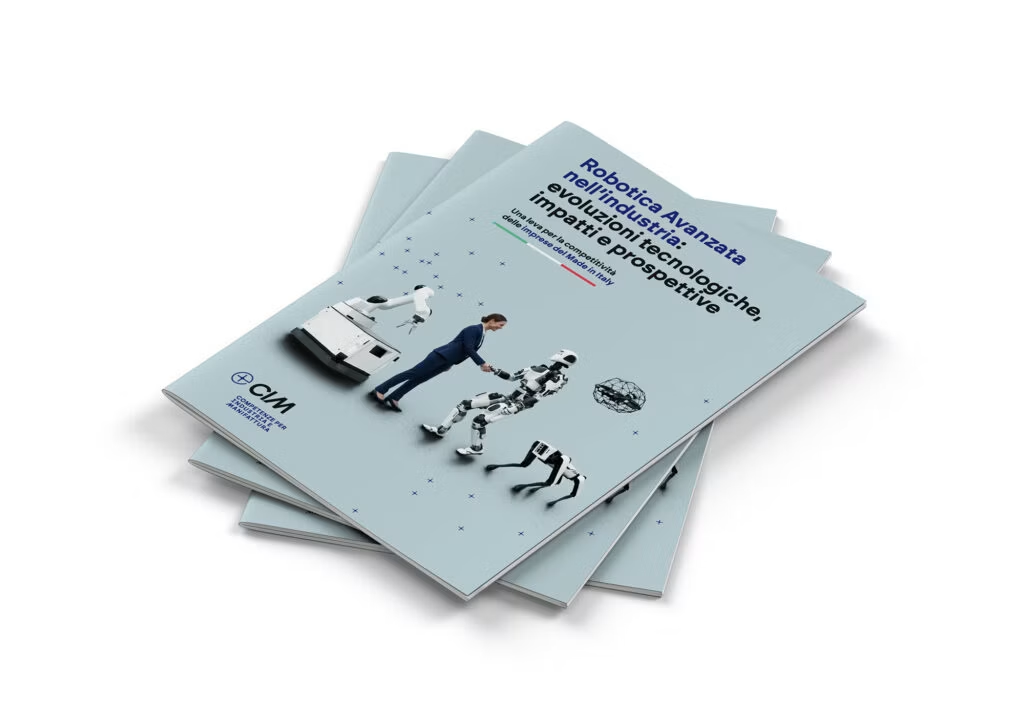
Why a white paper on robotics?
Robotics is undergoing a transformation: technologies, roles, and relationships within the factory are evolving.
This White Paper guides you through the landscape of Advanced Robotics, exploring AI and new cobots.
It maps global players, providers, and startups, offering useful criteria for selecting partners. It presents real industrial examples to help move from concept to application. It addresses obstacles, risks, and regulatory issues with a pragmatic approach, while focusing on the decisive factor: the new skills that will truly be required.
Contributors

Produced by CIM – Competencies for Industry and Manufacturing – with contributions from FEV, Politecnico di Torino, and Stellantis.
In collaboration with Artes 4.0 and the Advanced Robotics Joint Lab.
A project that integrates applied research expertise, systems engineering, and industrial strategy, with the aim of offering a vision that is both rigorous and operationally useful.
Target Audience
The document is intended for professionals who, at various levels, lead industrial and technological transformation processes.
CEOs and General Managers tasked with defining medium-to-long-term competitiveness strategies. CTOs and technical managers who design and integrate CPS and AI architectures. Plant Managers committed to managing efficiency and production variability. Innovation Managers and those responsible for process digitalization. SMEs intending to access advanced robotics through sustainable adoption models.
Success Stories
The use cases presented describe solutions already implemented and characterized by a high level of technological maturity. We have collected concrete and virtuous examples of companies and organizations that have already adopted advanced robotics, offering useful insights and inspiration for the evolution of future application scenarios in the industrial world.
You will find applications from: Gaia, SUPSI – University of Applied Sciences and Arts of Southern Switzerland, Prensilia, Reply, Thales Alenia Space, Laser Navigation, TIM Enterprise, and Siemens.
White Paper Table of Contents
1. Introduction
The technological and competitive context surrounding the evolution of robotics.
2. Evolution of robotics in industry
From traditional robotics to the intelligent and collaborative systems of Industry 5.0.
3. Sector overview
Market data, socio-economic drivers, and global evolutionary trajectories.
4. Impacts on productivity
and competitiveness
How Advanced Robotics affects efficiency, resilience, and industrial positioning.
5. Opportunities
and adoption challenges
Skills, governance, cybersecurity, and investment models.
6. Use cases and success
stories
Concrete applications and measurable results in real industrial contexts.
7. Strategic recommendations
Guidelines for building a sustainable implementation roadmap.
Conclusions
Evolutionary trends and implications for Italian companies.