
On September 24, 2026, CIM presented the Position Paper “Measure to Choose. Invest to Grow.” to the Senate. The meeting provided an opportunity to bring a perspective developed through working with manufacturing companies into the political debate: the obstacles they face when trying to innovate and grow, and how industrial policy can intervene.
The meeting, held at the initiative of Senator Marco Meloni, brought together Raffaele Spallone from the Ministry of Enterprises and Made in Italy, the Honorable Giulia Pastorella, and Senators Lorenzo Basso and Luigi Nave. CIM brought to the table the issues observed in its daily work with companies and a question for industrial policy: how to ensure that innovation and public resources generate greater productivity, growth capacity, and access to new markets?
From working with companies to the Position Paper
The paper draws on the experience CIM has gained over seven years of activity and engagement with over two thousand companies. An observation that extends from production floors to investment decisions and the difficulties encountered in adopting a technology.
From this work emerges the importance of continuity of support. A stable partner helps the company identify priorities, test solutions, and verify their results in production. The investment can thus become part of a development pathway.
"The necessary production capacities are often already present within the company. The obstacle is one of skills."
The challenge is to extend this approach to companies that currently remain on the margins of innovation pathways. The document focuses on micro, small, and medium-sized manufacturing enterprises with potential for growth, innovation, diversification, or aggregation, recognizing that situations of structural crisis require specific instruments.
Paper contents: productivity and growth in size
The paper’s first message concerns two complementary levers.
The first is to increase productivity within companies through technologies, organization, skills, and managerial capabilities. The second is to enable companies that can grow to increase their scale, aggregate, attract capital, and reach new markets.
Greater size can make investments and expertise sustainable that a small organization struggles to finance. However, the relationship between scale and productivity must be read together with management quality, specialization, and markets served.
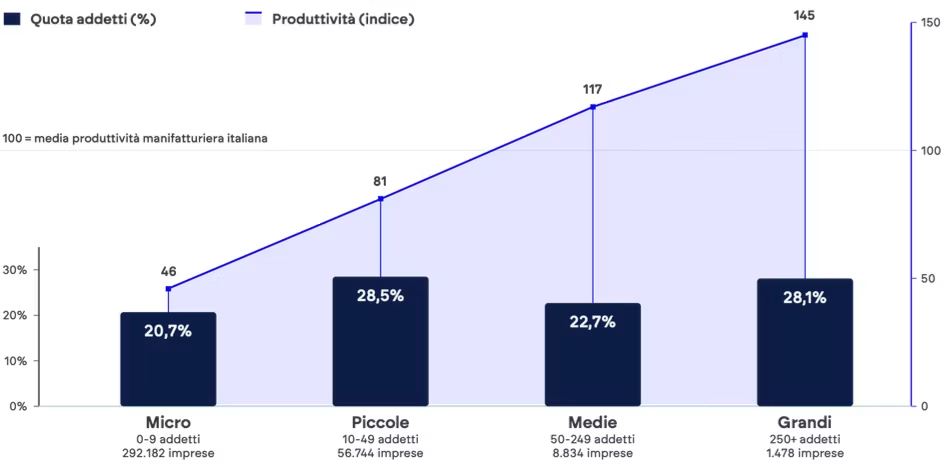
In the debate, Lorenzo Basso emphasized precisely this distinction: the issue is to create the conditions for a company with market capacity to develop. For industrial policy, this means also addressing the obstacles that make growth difficult or unattractive, from compliance requirements triggered by threshold crossings to access to capital.
Diversifying Markets by Leveraging What the Company Knows How to Do
A second insight concerns dependence on few clients. A company tied to a single client can improve its efficiency, but its growth prospects remain conditioned by that client’s demand.
The paper proposes working on diversification of clients and supply chains based on existing production capabilities. Expertise in materials, precision mechanics, or production processes can find application in different sectors, provided the company can meet their requirements.
Hence the proposal to support industrial qualification pathways and involve lead companies in supplier development. With one precise condition: skills, qualifications, and capabilities acquired through public support must be usable with other clients as well. In this way, the intervention strengthens the company’s autonomy and expands its market opportunities.

Technology and Training Within the Same Project
To adopt a new technology requires people capable of using it and processes able to integrate it. The document therefore proposes more closely linking technological investments, training, and production needs.
The Integrated Innovation Contract would bring together in a single pathway projects that combine multiple components, such as digital, artificial intelligence, automation, energy efficiency, and industrial qualification. Experimentation before investment would help verify the usefulness of solutions under representative conditions.
The Training-Innovation Voucher would instead link training to a concrete company project. Content would start from problems identified in the company; verification would concern skills acquired and their effect on work.
Measuring What Changes After the Investment
The paper’s title also expresses a methodological proposal: evaluate the effects of interventions over time.
Resources disbursed, projects financed, and courses delivered describe the activity carried out. To understand how much a policy has contributed to competitiveness requires also observing value added per employee, new clients, exports, consumption per unit of product, and private capital mobilized.
Raffaele Spallone emphasized the centrality of evaluation for guiding and correcting public instruments. The paper proposes an independent system that follows companies after interventions, also using already available administrative data.
Among the indicators is time: how long passes from diagnosis to experimentation and from experimentation to production. For a company, the speed of this pathway affects the ability to seize a market opportunity.
Proposals for 2027–2031
The paper translates this analysis into a National Plan for the Competitiveness of MSMEs 2027–2031. The seven proposals act on three linked fronts: creating the conditions for growth in size, strengthening innovation and skills, and measuring the effects of policies.
- Dimensional Growth Pathway, to make the transition between thresholds more gradual and favor business development.
- MPMI Aggregation Program, to support company valuation, aggregations, and access to capital.
- National Guidance and Support Service, with an initial diagnosis and a contact person throughout the pathway.
- Integrated Innovation Contract, to coordinate the various components of transformation projects.
- Training-Innovation Voucher, linked to company needs and projects.
- National Impact Measurement System, to track results over time.
- Funding proportional to co-investment, to value the Competence Centers’ ability to attract industrial demand and private resources.
Measurement also concerns Competence Centers. CIM proposes evaluating its own work through the results produced for companies, maintaining a stable base for applied research and the relationship with universities.
Conclusion
To increase manufacturing productivity, it is necessary to act within companies and, at the same time, allow those with potential to grow, consolidate, and reach new markets. Public investments must be judged by the changes they produce over time: productivity, competitive capacity, and activated private capital.
The discussion in the Senate brought this proposal to the attention of the institutions. The paper offers a starting point for discussing tools, implementation times, and criteria for verifying their effects.
Paper Authors
Enrico Pisino CEO CIM, Competenze per Industria e Manifattura
Matteo Bandiera Program Manager – AI for Industry & Digital Integration, CIM
Graziana Di Gangi Communication & Marketing Specialist, CIM
Giulia Marcocchia Co-Scientific Director, CIM Academy / Associate Professor of Strategy and Innovation Management, CY Cergy Paris Université / Senior Researcher at Transition Design Lab.
Eleonora Marino Head of Innovation & Venture Lab, CIM
Davide Martignetti President, Libre Sc / Communication and Marketing Consultant, CIM / Professor, IAAD
Daniele Salvaggio CEO, Imprese di Talento / Institutional Relations, CIM
Initiative and paper in collaboration with Imprese di Talento