
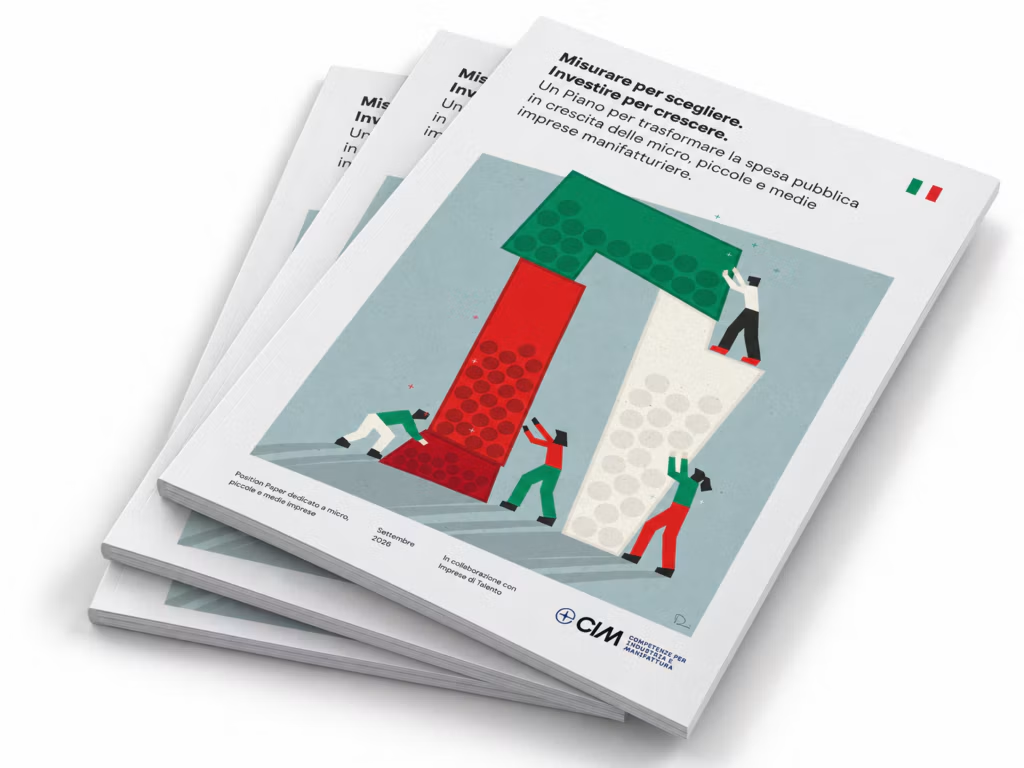
Why a paper on MSME competitiveness?
How can public investment be transformed into greater productivity and business growth? The Position Paper addresses this question based on CIM’s experience in technology transfer and analysis of the Italian manufacturing sector.
The document proposes action on two complementary levers: improving productivity within companies and creating the conditions for them to grow, aggregate, attract capital, and access new markets. Technologies, skills, and organization thus enter a development pathway whose results can be measured over time.
Contributors
Developed by CIM – Competenze per Industria e Manifattura, in collaboration with Imprese di Talento, the paper is authored by Enrico Pisino, Matteo Bandiera, Graziana Di Gangi, Giulia Marcocchia, Eleonora Marino, Davide Martignetti, and Daniele Salvaggio. The foreword is by Enrico Pisino.
The document was presented to the Senate on September 24, 2026, and stems from seven years of supporting companies through innovation pathways.
Target Audience
The paper is addressed to entrepreneurs and managers of micro, small, and medium-sized manufacturing enterprises with potential for growth, innovation, market diversification, or aggregation. It also offers a basis for discussion to institutions, trade associations, Competence Centers, and technology transfer actors engaged in defining and implementing industrial policies.
Seven proposals for competitiveness
Within a National Plan for MSME Competitiveness 2027–2031, the document articulates seven operational proposals across three axes: dimensional growth and scale; efficiency, innovation, and skills; measurement and institutional capacity.
- Dimensional Growth Pathway: make the transition between thresholds more gradual and remove obstacles that hinder business development.
- MSME Aggregation Program: support aggregations and access to capital to strengthen competitive capacity.
- National Competitiveness Guidance and Support Service: provide an initial diagnosis and a stable reference throughout the investment pathway.
- Integrated Innovation Contract: coordinate technologies, skills, and process transformation in a single project.
- Training-Innovation Voucher: link training to company needs and projects to be implemented.
- National Impact Measurement System: assess over time the effects of interventions on productivity, growth, and competitiveness.
- Funding proportional to co-investment: recognize the ability of Competence Centers to attract industrial demand and private resources.
What you’ll find in the paper
1. The problem: MSME competitiveness and productivity
The structure of the Italian production system, the relationship between size and productivity, and obstacles to growth.
2. Efficiency and innovation as levers of competitiveness
Costs, technologies, skills, and the ability to transfer innovation into industrial processes.
3. From dual transition to industrial competitiveness
The role of institutions and the conditions for making public support more accessible and consistent with company pathways.
4. An integrated strategy for MSME competitiveness
The 2027–2031 framework, the three intervention axes and seven proposals, with tools, timelines, and cost estimates.
5. Integration and implementation of the proposals
The implementation sequence and the role of Competence Centers in supporting companies.
6. Conclusions and further insights
The priorities for an industrial policy based on results. The appendices include the CIM case, evidence on the Competence Center network, illustrative simulations, and topics for further exploration. The document is completed by 45 bibliographic references.
